

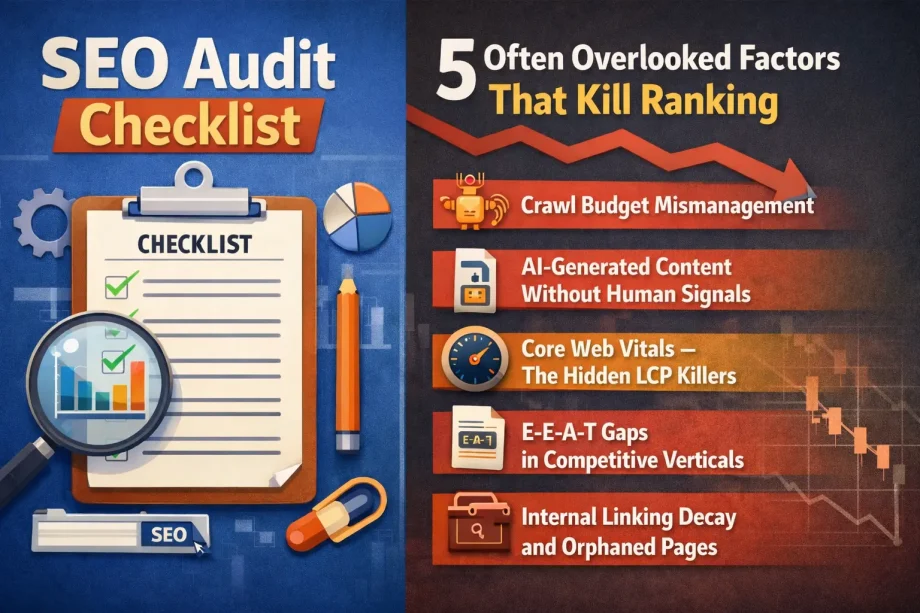
SEO Audit Checklist : 5 Often Overlooked Factors That Kill Ranking
Running an SEO audit in 2026 isn’t the same as it was three years ago. Google’s AI-powered algorithms have fundamentally changed how rankings are earned and — more painfully — how they’re lost. The technical basics (meta tags, broken links, XML sitemaps) still matter. But they’re table stakes now. The factors that are actually decimating organic traffic? Most auditors never even check them.
This guide, compiled by the team at Website Traffic Online, breaks down the five most dangerous overlooked ranking killers — complete with practical checklists, real-world impact data, and actionable fixes you can implement this week.

Crawl Budget Mismanagement
Your crawl budget — the number of pages Googlebot will crawl on your site within a given timeframe — is a finite resource. And in 2026, most mid-to-large websites are burning it on the wrong pages. Faceted navigation, infinite scroll pagination, duplicate content from URL parameters, and staging environments accidentally indexed are the top offenders.

The most dangerous misconception is believing that Googlebot “will figure it out.” It won’t — not within any reasonable timeframe. When your budget is spent on low-value pages, your high-value money pages get crawled less frequently. Fresh content doesn’t get indexed. Rankings stagnate even when everything else looks healthy.
The 2026 wrinkle: Google’s crawler now deprioritizes JavaScript-heavy pages that take longer to render. If your SPA or React-based site has no server-side rendering, you may be consuming 3–5× more crawl budget than a comparable static site — with significantly fewer pages actually indexed.

AI-Generated Content Without Human Signals
Google has not penalized AI content — but it has aggressively downranked AI content that lacks what we now call “human authenticity signals.” This is the single biggest misunderstanding in the content marketing world right now. It’s not about whether the content was written by a human or a machine. It’s about whether the content demonstrates first-hand experience, original insight, and genuine editorial intent.

The practical implication: publishing thousands of AI-generated articles with no unique data, no first-person experience, and no author credentials is a ticking time bomb. Google’s Helpful Content system has moved from a site-level signal to a page-level signal, meaning one section of low-quality AI content can now suppress the rankings of your entire domain.

Core Web Vitals — The Hidden LCP Killers
By 2026, nearly every SEO professional knows Core Web Vitals exist. What most don’t realize is that the “pass” threshold Google uses for rankings is stricter than what most diagnostic tools show — and that Largest Contentful Paint (LCP) failures are now the dominant CWV ranking signal, having overtaken CLS (Cumulative Layout Shift) as the most impactful metric.

The overlooked LCP killer? Third-party scripts loading above the fold. Ad networks, heatmap tools, chat widgets, and social proof popups are silently demolishing your LCP scores — and most site owners don’t connect the dots because they don’t measure on real mobile devices over cellular connections.
Critical 2026 update: Google’s CrUX (Chrome User Experience Report) data — not your lab scores from PageSpeed Insights — is what determines your ranking treatment. A site scoring 85 in the lab but 55 in the field will be treated as a poor performer.

E-E-A-T Gaps in Competitive Verticals
Experience, Expertise, Authoritativeness, and Trustworthiness (E-E-A-T) isn’t new — but the way Google evaluates it has changed dramatically. In 2026, E-E-A-T is no longer just a content quality signal for YMYL (Your Money, Your Life) topics. It’s now a broad-spectrum ranking factor that affects almost every niche, and the gap between high-E-E-A-T and low-E-E-A-T sites has widened considerably after the March 2024 and September 2025 core updates.

What most sites overlook is the off-site E-E-A-T dimension. Google assesses your expertise not just from your own content, but from how you’re referenced across the web — Wikipedia, industry publications, podcast mentions, social proof, forum citations. If your brand appears nowhere credible outside your own domain, your on-page E-E-A-T investments have a ceiling.

Internal Linking Decay and Orphaned Pages
Internal linking is the most underrated lever in technical SEO. While everyone chases backlinks, their own internal link architecture is quietly rotting. Sites publish hundreds of new pages every year without updating old content to link to them — creating “orphaned pages” that Googlebot discovers infrequently (or never). Worse, link equity isn’t flowing to the pages that need it most.

The subtler issue is “internal link decay.” As websites grow, old popular pages accumulate internal links while new priority pages receive few. Over time, your PageRank distribution skews heavily toward legacy content — often product pages or blog posts that are no longer strategic priorities. A deliberate internal linking strategy re-routes equity to where it matters.

2026 SEO Audit Priority Matrix

Where to Start Your 2026 SEO Audit
The most common mistake is trying to fix everything at once. Prioritize based on the severity-to-effort ratio. Start with crawl budget and internal linking — both are quick wins with outsized impact. Then move to E-E-A-T improvements, which compound over time as you build brand authority.
Core Web Vitals and AI content signals require ongoing monitoring, not one-time fixes. Schedule quarterly CWV checks using real field data (CrUX), and build an editorial process that systematically adds human experience markers to every piece of content that goes out.
Most importantly: run your audit with fresh eyes. The factors above are dangerous precisely because they’re invisible to teams that are too close to their own site. Get a second opinion, use multiple crawling tools, and always cross-reference lab data against real field performance. The gap between the two is where your ranking killers are hiding.

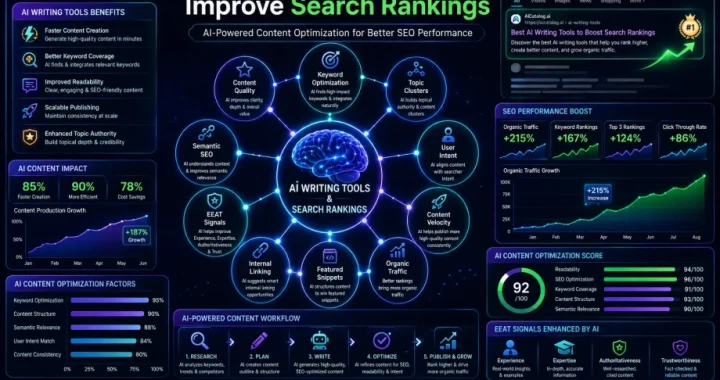 How AI Writing Tools Improve Search Rankings
  Top Local UK-Based SEO Agencies to Watch This Year


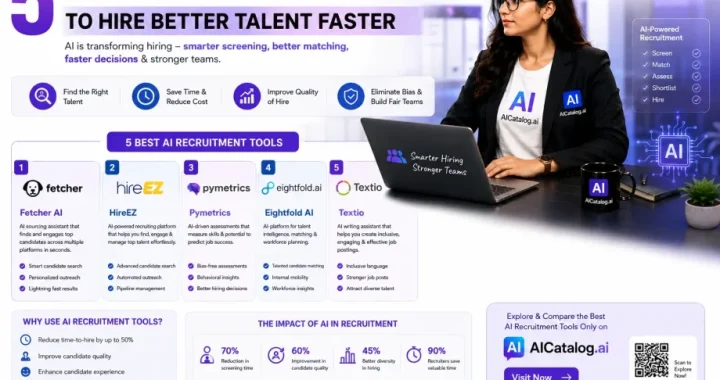 5 AI Recruitment Tools to Hire Better Talent Faster
 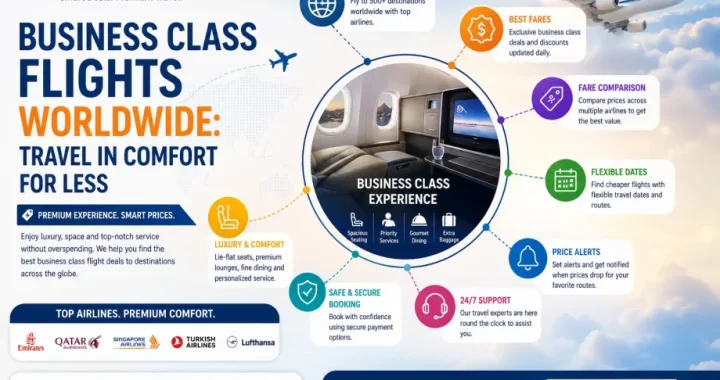 Business class flights worldwide: Travel in comfort for less
  The ultimate guide to finding Delta Air Lines flash sales and daily deals