
AI isn’t “coming to marketing” anymore—it’s already sitting in the campaign dashboard, writing the drafts, optimizing budgets, and predicting what your customers will do next. In 2026, the advantage won’t go to the brands that use AI, but to the ones that use it intentionally: with cleaner data, tighter creative systems, better customer experiences, and smarter measurement.
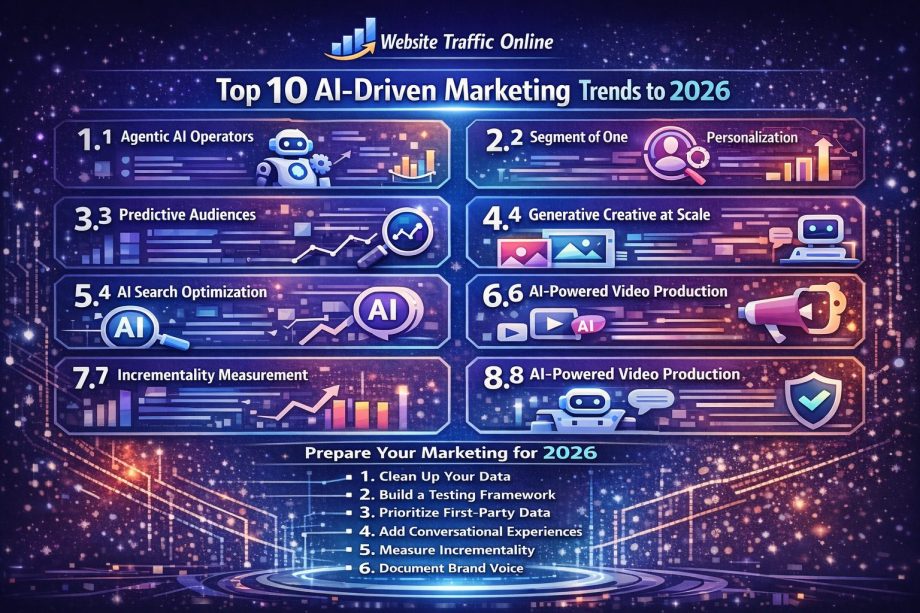
At Website Traffic Online, we’re watching a clear shift: marketing teams are moving from AI as a tool to AI as an operating system. Here are the top 10 AI-driven marketing trends shaping 2026—and how to prepare for each.
1) Agentic AI Becomes Your Always-On Marketing Operator
In 2026, AI is graduating from “assistant” to “agent.” Instead of only generating ideas or copy, agentic systems can execute workflows: researching competitors, building campaign structures, generating variations, launching tests, adjusting bids, and reporting results—with humans approving the guardrails.
What this means for marketers:
- Faster campaign cycles (hours, not weeks)
- More experiments running at once
- Better performance through continuous optimization
What to do now:
Create repeatable playbooks (audience rules, brand voice, offer logic). AI agents thrive when you define constraints and success metrics clearly.
2) Hyper-Personalization Shifts to “Segment of One”—Without Being Creepy
Personalization in 2026 isn’t just “Hi, [First Name].” It’s dynamic messaging that adapts to intent, context, and timing—across email, web, ads, and even customer support. AI can infer what a visitor wants based on behavior and show the most relevant content in the moment.
Key evolution: personalization will rely less on third-party data and more on first-party signals (site actions, CRM history, product usage, and declared preferences).
What to do now:
Start with “safe personalization”: tailor content by stage and intent (new visitor vs. returning, pricing page viewers, abandoned cart) rather than sensitive personal attributes.
3) Predictive Audiences Replace Reactive Targeting
Instead of targeting based on who someone was (demographics, broad interests), AI increasingly targets based on what someone is likely to do next: purchase probability, churn risk, upsell readiness, or likelihood to become a repeat buyer.
Examples:
- “High intent within 7 days” audience for retargeting
- “Likely to churn” triggers for retention offers
- “Ready for upsell” sequences for customer lifecycle marketing
What to do now:
Make sure your conversions and lifecycle events are well-defined and consistently tracked. Predictive systems are only as smart as your event data.
4) Generative Creative at Scale (But Winning Comes from Systems, Not Volume)
Yes, AI can produce 100 ad variations in minutes. But in 2026, the brands winning aren’t simply producing more—they’re building creative systems: modular messaging, reusable assets, and clear testing hypotheses.
What changes:
- More creative iterations
- Shorter creative fatigue cycles
- Faster feedback loops from performance data
What to do now:
Build a “creative matrix”: pain points × offers × angles × formats. Then use AI to generate variations within a controlled framework.
5) AI Search Optimization Expands Beyond Traditional SEO
Search is evolving. People still use Google, but they also use AI tools and conversational interfaces to discover products, compare options, and get recommendations. In 2026, optimization isn’t just about ranking blue links—it’s about being the most understandable and quotable source across platforms.
What to focus on:
- Clear product/service positioning
- Strong FAQs and explainer content
- Structured data and clean site architecture
- Original insights, case studies, and proprietary examples
What to do now:
Double down on content that answers high-intent questions with clarity. “Best practices” content is easy to generate; proof-based content stands out.
6) Conversational Landing Pages & AI Sales Assistants Become Normal
Static landing pages are giving way to interactive experiences: chat-based product finders, onboarding flows, and AI assistants that guide users to the right plan, bundle, or next step.
Why it matters:
- Higher conversions through guided discovery
- Better qualification before sales calls
- Lower support load and faster response times
What to do now:
Add conversational layers where users get stuck: pricing pages, product comparisons, and checkout. Train assistants on your knowledge base, policies, and brand voice.
7) Marketing Measurement Leans Into Incrementality and Causal Testing
With tracking changes and privacy constraints, marketers are moving away from “perfect attribution” and toward “what actually moved the needle.” AI helps by modeling results, detecting patterns, and recommending experiments—but the gold standard is still incrementality testing.
In 2026, expect more:
- Lift tests and geo experiments
- Modeled attribution and media mix modeling (MMM)
- Blended dashboards that combine platform + first-party data
What to do now:
Define a measurement strategy that doesn’t collapse when one platform’s tracking changes. Build a baseline of KPIs that reflect real business outcomes.
8) AI-Powered Video and Synthetic Production Reshape Content Economics
Producing quality video used to be expensive and slow. In 2026, AI accelerates ideation, scripting, editing, captioning, and versioning—making video a default format for many brands.
What changes:
- Rapid repurposing: long video ? 20 shorts
- Faster localization for regions/languages
- Scaled UGC-style creatives (while maintaining authenticity)
What to do now:
Invest in a strong “source content” strategy: webinars, interviews, product demos, founder POV. AI can multiply output—but it needs high-quality inputs.
9) Brand Voice Consistency Becomes a Competitive Advantage
As more content is generated by AI, the internet gets noisier and more generic. In 2026, brands that stand out will have a distinct, consistent voice—across ads, emails, social, blogs, and support. AI can help maintain consistency when it’s trained on brand guidelines and approved examples.
What to do now:
Create a simple brand voice kit:
- Voice traits (e.g., direct, friendly, expert)
- Do/Don’t examples
- Approved phrases and positioning
- Audience-specific tone adjustments
At Website Traffic Online, we see this as a major differentiator: AI makes speed easy; coherence is harder—and more valuable.
10) Responsible AI Marketing Becomes Mandatory, Not Optional
Consumers and regulators increasingly expect transparency, fairness, and privacy. Brands will need to prove they’re using AI responsibly—especially in targeting, claims, and customer interactions.
Common expectations in 2026:
- Clear disclosures where appropriate
- Avoiding discriminatory targeting or exclusion
- Data minimization and consent-first practices
- Human review for sensitive outputs
What to do now:
Create internal rules: what AI can automate, what needs approval, and what data sources are allowed. Responsible AI protects trust—your most valuable asset.
How to Prepare Your Marketing for 2026
AI-driven marketing isn’t just about adopting new tools—it’s about upgrading your operating model. Here’s a quick action plan you can implement immediately:
- Clean up your tracking and events (conversion, lead quality, lifecycle milestones)
- Build a creative testing framework instead of random variation generation
- Prioritize first-party data through email, CRM, and on-site behavior
- Add conversational experiences on high-intent pages
- Measure incrementality with experiments, not just platform reports
- Document brand voice so AI output stays consistent and on-brand
Final Thoughts (Website Traffic Online)
In 2026, AI will reward marketers who combine automation with judgment. The winners will be the teams that move faster and keep their message clear, their measurement honest, and their customer experience human.
If you want Website Traffic Online to help you apply these trends—through AI-powered SEO, conversion optimization, performance campaigns, and content strategy—start by auditing your funnel and data. When your foundation is solid, AI becomes a growth engine instead of a content machine.